Doug Chapin Runs for Congress in Minnesota District Six
Doug Chapin
Statement from the Candidate:
“Doug Chapin is running to represent Minnesota’s Sixth Congressional District after a long career as a nationally recognized expert and media commentator on democracy and elections. He spent nine years studying politics, government and law and has over 35 years of experience working in and around public service. Doug served as an attorney in Congress, represented clients in private law practice, and worked as an advocate for federal, state and local election reform nationwide – and built the nation’s first online certificate program in election administration for the University of Minnesota’s Humphrey School of Public Affairs. Doug and his partner Stephanie Tomlinson own Sweater Vest Strategies, a Minnesota-based policy research and advocacy firm. He also is the host of Civics Anonymous, a regular series of nonpartisan discussions on the inner workings of law and government behind the current headlines. Doug is the father of three adult children and lives in Hanover.”
(Paraphrased from one of today’s Star Tribune newsletter emails:)
A growing number of school board members want Minnesota to reverse its transgender athlete policy. More than 150 school board members have signed a letter calling on the state to comply with a federal mandate that forbids transgender athletes from competing in high school girls sports.
After almost two days of circulation, the number of signees rose to about 7% of the state’s school board members on Tuesday, including large chunks of the boards in the Lakeville, Anoka-Hennepin, and Farmington districts.
Money is on the line, … Elliot Hughes reports. Officials warned that Minnesota could lose federal education funding if the state Department of Education and the MSHSL don’t change their policies by Friday.
“Every dollar really counts,” said Matt Swanson, chair of the Lakeville school board, who was a signee. “It’s a funding issue. I’m not trying to get on the soapbox.”
But in a response Tuesday to the members’ letter, state Attorney General Keith Ellison said complying with the federal government’s “bullying of transgender kids” would violate the Minnesota Human Rights Act.
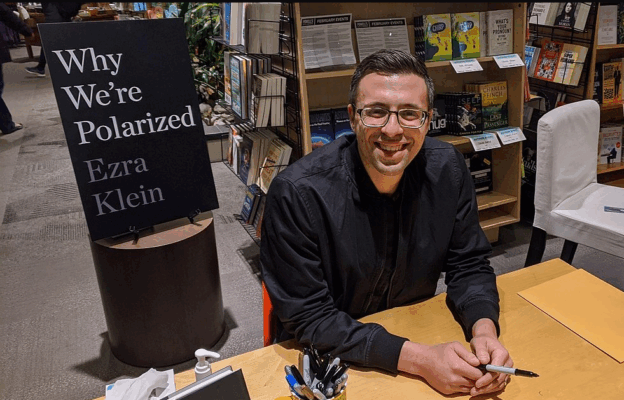
Ezra Klein in 2020 on his book tour for Why We’re Polarized, 12 February 2020. copyright Ezra Klein. Creative Commons Attribution-Share Alike 4.0 International license.
How Can Politicians Connect with Their Base?
What makes a candidate popular? Here is an interesting point of view. In a recent interview with David Remnick, published by The New Yorker, Ezra Klein argues, “one of my most strongly held views about politics is that the most important question for voters is not whether they like the politician but whether the politician likes them.” Klein believes that the worst part of Hillary Clinton’s infamous “deplorables” speech, from 2016, was her use of the word “irredeemable” to describe Trump voters. “When you begin to talk like that, it’s a severing of political community,” Klein said. Instead, he believes that Barack Obama modelled the ideal type of politics, by offering a “very open-palmed approach.”
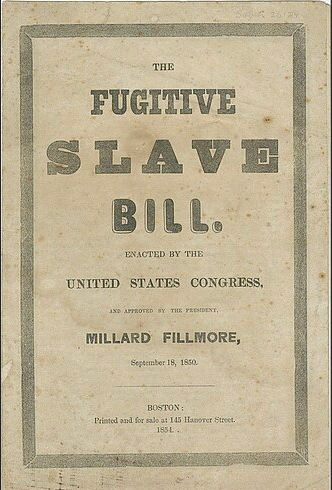
This printing of the Fugitive Slave Bill was sponsored by anti-slavery groups as a protest against the new law that required local and state authorities to assist slave owners in retrieving slaves. National Museum of African American History and Culture; Collection of the Smithsonian National Museum of African American History and Culture, published by the American Anti-Slavery Society. {{PD-US}} – US work that is in the public domain in the US for an unspecified reason, but presumably because it was published in the US before 1930.
Rewriting History and Culture in Our Museums
The Trump administration has attacked the Smithsonian museums and their exhibits for presenting America in a “negative light,” promoting “wokeism,” making Americans feel bad about their country, or for simply dwelling on “unpleasant” subjects, such as slavery, immigrants, gender — or even empowered women. There is mounting fear that some current exhibits and their related records will be destroyed due to pressure from the White House.
Regarding the Smithsonian museums, it was August 12th when the White House published a list of “objectionable” displayed works, claiming these promoted divisive narratives. Volunteer “citizen historians” are now photographing for the historic record many artworks and exhibits addressing race, immigration, and sexuality before they may be altered.
Pressure was felt even earlier as special exhibition plans were discarded (artist Amy Sherald’s canceled exhibition of her painting depicting a transgender woman resembling the Statue of Liberty) and existing exhibits were altered (references to Trump’s two impeachments removed but later revised and returned to the display in a less prominent position).
The administration justified its review of the public content in eight Smithsonian museums as an alignment of museum content with Trump’s cultural directives made in preparation for the United States’ 250th Anniversary.
Artists and museum professionals are worried. They see the restrictions soon extending to other museums and galleries, as well to theaters and performances of all kinds — not just in the art world but including other cultural and historical institutions providing public entertainment and education.
The artists have had mixed feelings about being targeted; some view it as a badge of honor, while others fear it may lead to self-censorship in the artistic community. Ibram X. Kendi, a prominent scholar on racism, fears that political censorship will harm serious scholarship on racism.
Have you come across recent suggestions online for the creation of a shadow cabinet in the United States?
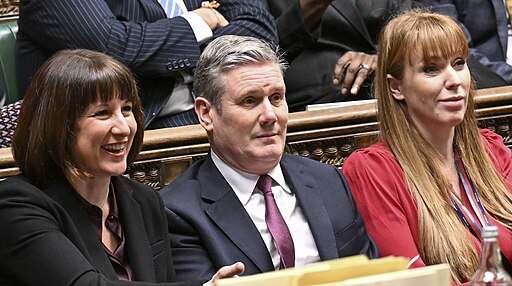
The concept of a shadow cabinet originated in Europe. In May 2021, a British think tank, the Institute for Government, wrote, “The shadow cabinet [in the UK] is made up of senior members of the main opposition party in Westminster who act as spokespeople for the opposition in specific policy areas. Shadow ministers are appointed by the leader of the opposition and generally take roles that mirror the current government. Their job is to scrutinize those they ‘shadow’ in government, and develop policies for their party.”
It is also possible that the shadow cabinet leader might create a shadow post not currently existing in government but which the opposition feels represents important policy.
Immediately after Donald Trump’s second election last November, Democratic politicians, including Representative Wiley Nickel, North Carolina (D), spoke about the need for a Democratic shadow cabinet. Inspired by the UK version, Nickel pointed out that a Democratic shadow cabinet would communicate what political policies the party supported.
In May, Senator Elissa Slotkin of Michigan proposed that ranking members of congressional committees could also be such a shadow cabinet.
Reporting this story, Politico expressed the concern that ranking members “are not the fresh faces who can give the Democratic Party a sleek new look.” Instead, Politico recommended, “Tap accomplished people with the ability to speak plainly and the credibility to puncture the Trump Administration’s often Orwellian narratives. Don’t limit members to professional politicians. Pitch a big tent. Don’t draw rigid ideological lines.”
Wiley Nickel, writing in The Washington Post, recommended choosing from the Democratic members of Congress but not necessarily the well-known ones.
Timothy Snyder, an American professor of Soviet history now teaching at the University of Toronto, argued that a shadow cabinet could help counteract the influence of oligarchy and authoritarianism, reminding citizens that a better government is possible. Such a cabinet can not only critique the government in power but also change the political landscape by proposing new ideas and solutions.