Category Archives: Posts & News

League of Women Voters Forum Video Links for School Board Candidates Deschenes, Payeur, and Simon

Anoka-Hennepin ISD 11 School Board Candidates. Videos Produced by QCTV for the League of Women Voters

See the Home Page for Voting Information links

District 3: Kacy Deschenes. On YouTube. On the LWVMN website.

District 4: Abbey Payeur. On YouTube. On the LWVMN website.

District 6: Jeff Simon. On YouTube. On the LWVMN website.
How Can Politicians Connect with Their Base?

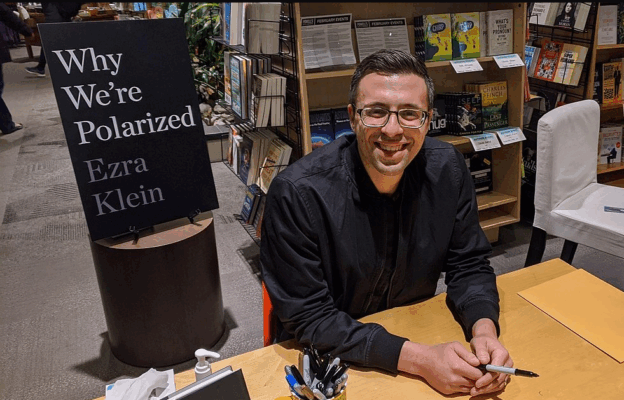
Ezra Klein in 2020 on his book tour for Why We're Polarized, 12 February 2020. copyright Ezra Klein. Creative Commons Attribution-Share Alike 4.0 International license.
Ezra Klein in 2020 on his book tour for Why We’re Polarized, 12 February 2020. copyright Ezra Klein. Creative Commons Attribution-Share Alike 4.0 International license.

How Can Politicians Connect with Their Base?

What makes a candidate popular? Here is an interesting point of view. In a recent interview with David Remnick, published by The New Yorker, Ezra Klein argues, “one of my most strongly held views about politics is that the most important question for voters is not whether they like the politician but whether the politician likes them.” Klein believes that the worst part of Hillary Clinton’s infamous “deplorables” speech, from 2016, was her use of the word “irredeemable” to describe Trump voters. “When you begin to talk like that, it’s a severing of political community,” Klein said. Instead, he believes that Barack Obama modelled the ideal type of politics, by offering a “very open-palmed approach.”

What do you think?
Educated We Stand

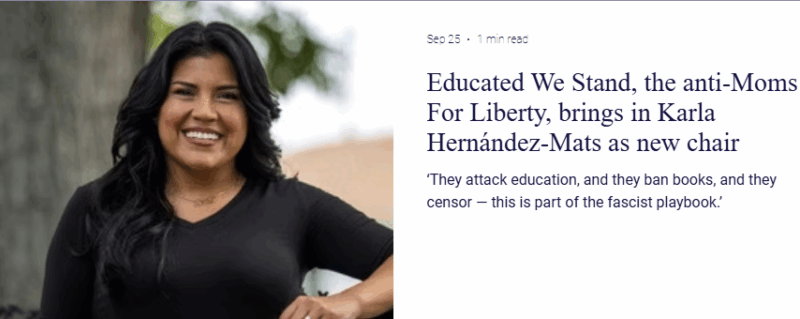
The new chairperson, Karla Hernández-Mats, of Educated We Stand

Educated. We Stand

I have recently become aware of this organization spearheaded by Jennifer Jenkins. They position themselves as opponents of Moms For Liberty in the fight to control school boards. Check out their website: Educated. We Stand and see what you think.

Early Voting Has Started! – Oct 2, 2025

Loading Viewer...

Rewriting History and Culture in Our Museums 

This printing of the Fugitive Slave Bill was sponsored by anti-slavery groups as a protest against the new law that required local and state authorities to assist slave owners in retrieving slaves

THE FUGITIVE SLAVE BILL, 1854

This printing of the Fugitive Slave Bill was sponsored by anti-slavery groups as a protest against the new law that required local and state authorities to assist slave owners in retrieving slaves. National Museum of African American History and Culture; Collection of the Smithsonian National Museum of African American History and Culture, published by the American Anti-Slavery Society. {{PD-US}} – US work that is in the public domain in the US for an unspecified reason, but presumably because it was published in the US before 1930.

Rewriting History and Culture in Our Museums 

The Trump administration has attacked the Smithsonian museums and their exhibits for presenting America in a “negative light,” promoting “wokeism,” making Americans feel bad about their country, or for simply dwelling on “unpleasant” subjects, such as slavery, immigrants, gender — or even empowered women. There is mounting fear that some current exhibits and their related records will be destroyed due to pressure from the White House.  

Earlier this year, when the National Park Service was required to remove all public signage that the administration found objectionable, park staff asked visitors to use their cameras to photograph all the signage before much of it was taken down and destroyed. Park visitors responded enthusiastically, and a thorough photographic record was taken and is being curated. 

Regarding the Smithsonian museums, it was August 12th when the White House published a list of “objectionable” displayed works, claiming these promoted divisive narratives. Volunteer “citizen historians” are now photographing for the historic record many artworks and exhibits addressing race, immigration, and sexuality before they may be altered.

Pressure was felt even earlier as special exhibition plans were discarded (artist Amy Sherald’s canceled exhibition of her painting depicting a transgender woman resembling the Statue of Liberty) and existing exhibits were altered (references to Trump’s two impeachments removed but later revised and returned to the display in a less prominent position).

The administration justified its review of the public content in eight Smithsonian museums as an alignment of museum content with Trump’s cultural directives made in preparation for the United States’ 250th Anniversary. 

Artists and museum professionals are worried. They see the restrictions soon extending to other museums and galleries, as well to theaters and performances of all kinds — not just in the art world but including other cultural and historical institutions providing public entertainment and education. 

The artists have had mixed feelings about being targeted; some view it as a badge of honor, while others fear it may lead to self-censorship in the artistic community. Ibram X. Kendi, a prominent scholar on racism, fears that political censorship will harm serious scholarship on racism.  

A Shadow Cabinet. What Is It?

Shadow Cabinet. Members of the opposition frontbench and shadow cabinet of Sir Keir Starmer, Leader of the Opposition and Leader of the Labour Party, at Prime Minister's Questions, 7 February 2024.
Shadow Cabinet. Members of the opposition frontbench and shadow cabinet of Sir Keir Starmer, Leader of the Opposition and Leader of the Labour Party, at Prime Minister’s Questions, 7 February 2024. © UK Parliament / Maria Unger. Licensed under the Creative Commons Attribution 3.0 Unported license

A Shadow Cabinet. What Is It?

Have you come across recent suggestions online for the creation of a shadow cabinet in the United States?

The concept of a shadow cabinet originated in Europe. In May 2021, a British think tank, the Institute for Government, wrote, “The shadow cabinet [in the UK] is made up of senior members of the main opposition party in Westminster who act as spokespeople for the opposition in specific policy areas. Shadow ministers are appointed by the leader of the opposition and generally take roles that mirror the current government. Their job is to scrutinize those they ‘shadow’ in government, and develop policies for their party.”

It is also possible that the shadow cabinet leader might create a shadow post not currently existing in government but which the opposition feels represents important policy.

Immediately after Donald Trump’s second election last November, Democratic politicians, including Representative Wiley Nickel, North Carolina (D), spoke about the need for a Democratic shadow cabinet. Inspired by the UK version, Nickel pointed out that a Democratic shadow cabinet would communicate what political policies the party supported.

In May, Senator Elissa Slotkin of Michigan proposed that ranking members of congressional committees could also be such a shadow cabinet.

Reporting this story, Politico expressed the concern that ranking members “are not the fresh faces who can give the Democratic Party a sleek new look.” Instead, Politico recommended, “Tap accomplished people with the ability to speak plainly and the credibility to puncture the Trump Administration’s often Orwellian narratives. Don’t limit members to professional politicians. Pitch a big tent. Don’t draw rigid ideological lines.”

Wiley Nickel, writing in The Washington Post, recommended choosing from the Democratic members of Congress but not necessarily the well-known ones.

Timothy Snyder, an American professor of Soviet history now teaching at the University of Toronto, argued that a shadow cabinet could help counteract the influence of oligarchy and authoritarianism, reminding citizens that a better government is possible. Such a cabinet can not only critique the government in power but also change the political landscape by proposing new ideas and solutions.

Sources

“Shadow Cabinet” https://www.instituteforgovernment.org.uk/explainer/shadow-cabinet

“Representative Wiley Nickel” https://youtu.be/OoJi4d3rBBs

Politico https://www.politico.com/news/magazine/2025/05/27/democrats-shadow-cabinet-brand-00353690

The Washington Post https://www.washingtonpost.com/opinions/2024/11/11/shadow-cabinet-democrats-opposition-trump/

Timothy Snyder, Thinking about…, “Shadow Cabinet, A Positive Form of Opposition,” https://snyder.substack.com/p/shadow-cabinet

Can Tylenol During Pregnancy Really Cause Autism? Really?

Autistic Spectrum Pride Flag. A rainbow nautilus, used to represent the autism spectrum, set on a background that takes the Disability Pride flag and moves the stripes to the side. Creative Commons Zero, Public Domain Dedication

Autistic Spectrum Pride Flag

A rainbow nautilus, used to represent the autism spectrum, set on a background that takes the Disability Pride flag and moves the stripes to the side. Creative Commons Zero, Public Domain Dedication

Can Tylenol During Pregnancy Really Cause Autism? Really?

“Don’t take Tylenol,” President Trump said, repeatedly emphasizing that pregnant people with fever should “tough it out” as much as they can, despite evidence that uncontrolled fever and infections during pregnancy can themselves increase risk of autism. (increase risk of autism)

In reality, 50 years of autism research shows that the condition arises from a complex mix of genetic and environmental factors. Hundreds of genes may be involved, and the presence or absence of any of them does not confirm that a person will have autism. There are also genetic mutations that have been attributed to the development of autism. If environmental factors play a role (e.g., taking Tylenol during pregnancy), their impact is not at all consistent, but without the genetic foundation, no individual will be negatively impacted by Tylenol or any other environmental factor. There are so many potential environmental factors that a person with a genetic predisposition is unlikely to be able to avoid them. The role of the environment is likely to trigger autistic symptoms or to increase their appearance in an individual. Therefore, it is basically accurate to say that the condition is primarily genetic.

What Is Autism?

Autism symptoms are often described as being on a spectrum. Dozens if not hundreds of behavioral symptoms can be listed for autism. Any combination of symptoms can present themselves. Similarly, the severity of the symptoms can vary greatly. Every autistic person is different. Moreover, autistic children often become naturally skilled at “masking” as they grow into adulthood. Masking means that autistic persons learn through experience and observation to restrain certain of their behaviors that negatively interfere with social, work, and family relations. Being diagnosed and learning about autism makes masking more effective and prevalent. Observers may think that the autistic person has become “better,” but that is not true. They have, however, become more skilled at controlling their behavior temporarily.

Autism, like ADHD–both described as neurodivergent behaviors–has been perceived to be on the rise in recent decades. This is an illusion. What has certainly increased is our scientific ability to define and detect the nuances of autism. (When I was young, autistic children were simply naughty children whose parents were lazy or not doing a good job of child rearing.) There may also be an environmental role played by the exponentially increasing technological stresses of our society. If we really wanted to remove potential environmental factors and stressors, we’d have to start by removing cell phones, the internet, and AI from our lives. Shall we go there?

I used the word neurodivergent. It describes a brain that functions differently in patterns and biochemical connections as compared to the neurotypical brain. Some of the divergencies are inefficient, but others are surprisingly creative and innovative. As science learns more, many diagnosed autistic persons come to understand that their condition is not a negative one, to be labeled a “disorder,” but an alternative mental adaptation that can sometimes make life better. Donald Trump and RFK, Jr. don’t have a clue.

Additional Sources

https://www.scientificamerican.com/article/autism-has-no-single-cause-research-shows/

https://www.pbs.org/newshour/health/heres-what-we-know-about-the-causes-of-autism

https://www.autismspeaks.org/science-news/autism-research-2024

https://autism.org/wp-content/uploads/2025/09/Understanding-Autism-Research-PDF-Final-Design.pdf

https://health.clevelandclinic.org/how-common-is-autism

https://health.clevelandclinic.org/adhd-vs-autism

https://health.clevelandclinic.org/for-females-with-autism-differences-matter

Meidas Health Emergency Episode: Combating Trump’s Deadly Autism Lies,” Brett Meidas (9/23/25).


Governor Walz Issues Executive Order to Safeguard Vaccine Access in Minnesota

Governor Walz Issues Executive Order to Safeguard Vaccine Access in Minnesota

On Monday, Governor Tim Walz issued an executive order directing the Minnesota Department of Health (MDH) to expand its efforts to safeguard vaccine access in Minnesota in response to federal actions restricting vaccine availability at the federal level. The executive order also directs the state epidemiologist to issue a standing order for the COVID-19 vaccine, which would provide greater flexibility for health care providers and pharmacists to provide the vaccine. 

“Vaccines are one of the greatest public health achievements in modern medicine,” said Governor Walz. “While the Trump Administration attempts to limit Americans’ access to preventative care, Minnesota will be guided by science and medical expertise, prioritizing the health and safety of our people.”